
How to Build Consistency in Your Daily Life (Even Without Motivation)
Consistency isn't about being perfect or feeling motivated every day. It's about building small habits, creating a simple system, and learning to get back on track when life gets in the way. Discover practical ways to build consistency and turn your goals into daily action.
On this page
- 1. Start Small, Even If Your Goal Is Big
- 2. Build a System Instead of Relying on Motivation
- 3. Choose One Priority Instead of Chasing Everything
- 4. Create a Minimum Version for Difficult Days
- 5. Track Your Actions So Progress Becomes Visible
- 6. Stop Treating a Missed Day Like Failure
- 7. Become Someone Who Takes Action
- 8. Make Your Environment Support Your Goal
- 9. Remember Why the Goal Matters to You
- How to Build Consistency Starting Today
- Step 1: Choose One Goal
- Step 2: Define One Daily Action
- Step 3: Set a Realistic Starting Point
- Step 4: Record What You Do
- Step 5: Review and Improve
- Final Thoughts: Consistency Is Built One Action at a Time
- Turn Your Goal Into a Plan
You start with excitement.
You make a plan, set a goal, and tell yourself that this time will be different. Maybe you want to get fit, learn a new skill, build a business, or finally work on something you've been postponing for months.
For the first few days, things go well.
Then life happens.
You get tired. Work piles up. Something unexpected comes along. You miss one day, then another. Before you realize it, the plan you were so excited about is sitting untouched.
And you start wondering, Why can't I stay consistent?
Maybe you think you lack discipline. Maybe you believe other people have stronger willpower than you. Or perhaps you tell yourself you'll try again when you feel motivated.
But here's something worth understanding: consistency isn't about doing everything perfectly. It's about making it easier to keep showing up, even when things aren't perfect.
You don't need to transform your entire life overnight. You need a realistic way to keep taking action.
Let's look at how to build consistency in your daily life, one step at a time.
1. Start Small, Even If Your Goal Is Big

One of the biggest mistakes people make is starting with too much.
You decide to get fit, so you plan to exercise for an hour every day. You want to learn a skill, so you schedule two hours of studying every evening. You want to build a business, so you expect yourself to work on it for several hours after your regular job.
It sounds ambitious. But is it realistic on a difficult day?
When your plan requires high energy, plenty of free time, and strong motivation, it's easy to abandon it as soon as your circumstances change.
Instead, start with an action you can realistically repeat.
- Want to read more? Start with two pages.
- Want to exercise? Begin with five minutes of movement.
- Want to learn a skill? Practice for ten minutes.
- Want to build a business? Complete one meaningful task.
The point isn't to limit what you can achieve. It's to make starting easier.
Once the habit becomes more familiar, gradually increase the time or effort. You can do more as your capacity grows.
Remember: your first job is to build consistency, not to prove how much you can do on your best day.
2. Build a System Instead of Relying on Motivation
Motivation feels great when it's there. The problem is that you can't always depend on it.
Some days, you feel ready to work. Other days, even a simple task feels exhausting. If your entire plan depends on how you feel, your progress will keep changing with your mood.
This is where a system helps.
A system gives you a way to take action without having to decide everything from scratch every day.
Start with three simple questions:
- What will I do? Define one clear action.
- When will I do it? Choose a realistic time or daily cue.
- Where will I start? Make the first step obvious.
For example, instead of saying, "I'll learn video editing this week," decide:
"I'll practice editing for 15 minutes after dinner, starting with one short clip."
Now you know what to do and when to begin.
You can make this even easier by preparing your environment in advance. Put your workout clothes where you can see them. Keep your book beside your bed. Open the document you need before finishing work for the day.
Every unnecessary decision creates another opportunity to delay.
Make the next action clear, reduce friction, and give yourself fewer reasons to put it off.
3. Choose One Priority Instead of Chasing Everything
Sometimes, the problem isn't laziness or a lack of discipline. It's trying to do too many things at once.
You want to improve your health, increase your income, learn new skills, read more, and work on several business ideas. Every goal feels important, so you try to make progress on all of them.
Eventually, your attention gets divided, your plans become overwhelming, and nothing receives enough consistent effort.
Try a different approach.
Choose one priority that matters most right now. You don't have to abandon your other ambitions forever. You simply need to decide where your main effort will go during this period.
Then break that priority into smaller actions.
For example, if your goal is to launch a digital product, your next actions might be:
- Decide what problem the product will solve.
- Outline the product.
- Create the first version.
- Prepare the product page.
- Publish and improve it.
You no longer have to think about the entire journey every day. You only need to identify the next useful step.
A big goal becomes easier to work on when you stop treating it as one enormous task.
4. Create a Minimum Version for Difficult Days
Here's a question worth asking:
What happens to your plan when you're tired, busy, or simply having a bad day?
If your answer is "I skip it," your plan may be too rigid.
A useful strategy is to create three versions of your daily action.
- Best day: What you can do when you have plenty of time and energy.
- Normal day: What you can reasonably manage most days.
- Difficult day: The smallest meaningful action you can complete when circumstances are challenging.
Imagine you're building an exercise habit.
Your best-day plan might be a full workout. Your normal-day plan might be a shorter session. Your difficult-day version might be five minutes of gentle movement.
For learning, it could mean studying for an hour on a good day, practising for 15 minutes on a normal day, and reviewing one concept on a difficult day.
This approach gives you flexibility without abandoning the goal.
Of course, rest matters too. If you're ill, injured, or genuinely exhausted, resting may be the right choice. Consistency doesn't mean ignoring your body's needs or forcing yourself to perform every day.
The aim is to avoid turning every imperfect day into a reason to quit.
5. Track Your Actions So Progress Becomes Visible
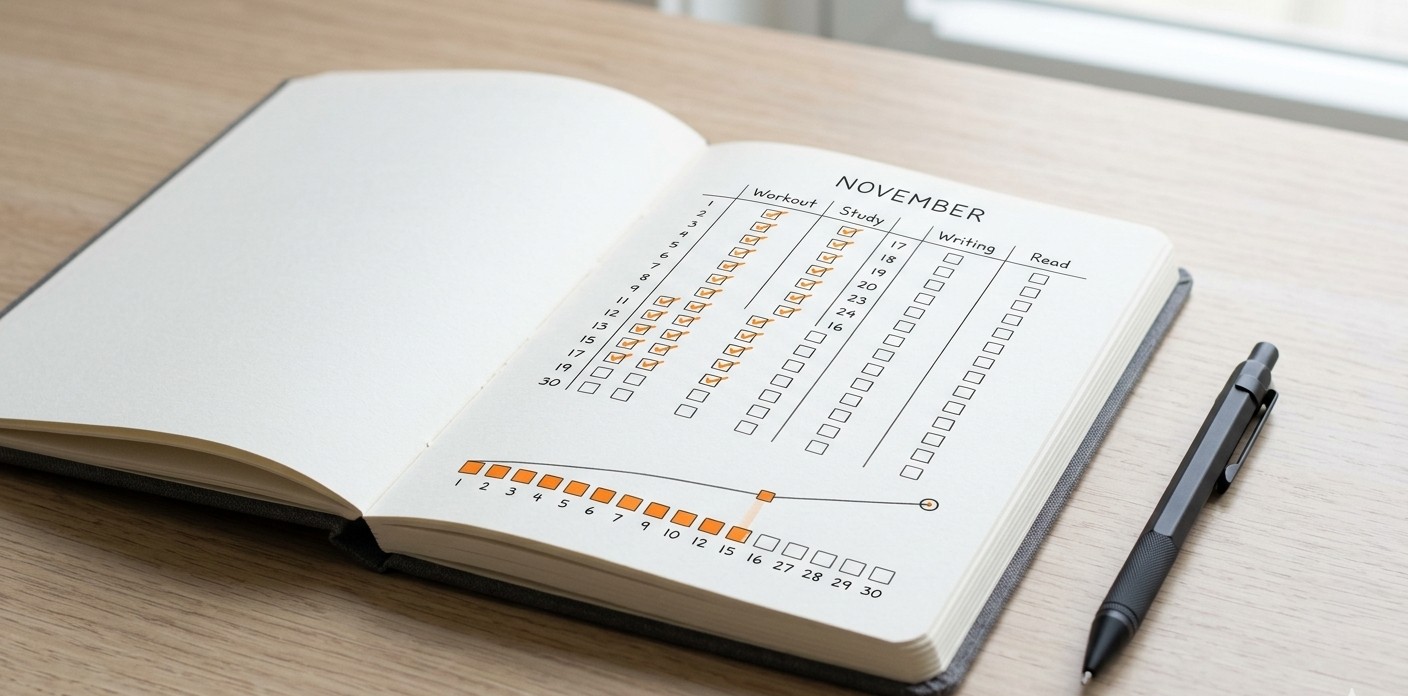
Progress isn't always obvious while you're making it.
You might practise a skill for two weeks and still feel like a beginner. You might exercise regularly without noticing dramatic changes. You might work on a business for days before seeing any results.
When progress feels invisible, it's easy to lose interest.
Tracking your actions gives you something concrete to look at.
You don't need a complicated spreadsheet or an elaborate productivity system. Start with a calendar, a notebook, or a simple habit tracker.
Record whether you completed the action you planned.
For example:
| Day | Planned action | Completed? |
|---|---|---|
| Monday | Practise for 15 minutes | Yes |
| Tuesday | Practise for 15 minutes | Yes |
| Wednesday | Review one lesson | Yes |
| Thursday | Rest due to illness | Rest |
| Friday | Practise for 15 minutes | Yes |
The purpose isn't to create a perfect streak. It's to understand your behaviour and make your effort visible.
Over time, your records can help you answer useful questions:
- Am I actually making time for this goal?
- Which days or situations make it harder?
- What kind of plan can I maintain?
- What have I completed that I might otherwise forget?
What gets measured becomes easier to notice. And what you notice, you can learn from.
6. Stop Treating a Missed Day Like Failure
You will miss days.
Your schedule may change. You may feel unwell. You may underestimate how long a task takes. Sometimes, you simply won't follow through.
That doesn't automatically mean you've failed.
The real problem often begins with the story you tell yourself afterward.
You miss one workout and think, "I've ruined my routine."
You skip a study session and think, "I'm never consistent."
Then one missed day becomes a week, and the week becomes another abandoned attempt.
Instead, treat a missed day as information.
Ask yourself what happened. Was the task too big? Was the timing unrealistic? Did something unexpected interfere? Did you need rest?
Use the answer to adjust your plan.
You can also follow a simple rule: return at the next reasonable opportunity instead of waiting for a fresh start.
If you miss Tuesday, you don't need to wait until Monday. If your morning routine falls apart, you can restart in the evening or the following day.
And if you miss several days, you can still return.
The goal isn't to protect an unbroken streak at all costs. It's to develop the ability to get back on track.
7. Become Someone Who Takes Action

The way you describe yourself can influence how you approach your goals.
If you repeatedly tell yourself, "I'm lazy," "I never finish anything," or "I can't stay consistent," those statements can start to feel like facts.
But your past behaviour doesn't have to define every future decision.
Instead of focusing only on the outcome you want, pay attention to the kind of person you're practising becoming.
Don't just aim to finish a book. Practise being someone who reads regularly.
Don't just aim to get fit. Practise being someone who makes time for movement.
Don't just aim to build a business. Practise being someone who consistently completes meaningful work.
This doesn't mean repeating an identity statement will magically change your behaviour. The important part is giving yourself evidence through action.
Every time you complete a planned task, however small, you have another example of yourself following through.
And when you don't follow through, you have an opportunity to learn and try again.
You don't have to wait until you feel like a disciplined person to act. Taking action is one way you gradually build trust in yourself.
8. Make Your Environment Support Your Goal
Willpower isn't your only tool. Your surroundings can make a behaviour easier or harder.
Think about how often you intend to work on something but end up scrolling on your phone, switching between tabs, or doing easier tasks instead.
You may not need more motivation. You may need fewer distractions.
Try making a few small changes:
- Keep your phone away while working on an important task.
- Prepare the materials you'll need before you start.
- Keep useful tools easy to access.
- Remove unnecessary steps between deciding to act and actually starting.
- Tell someone you trust what you're working toward and share occasional progress updates.
You can also attach a new habit to something you already do.
For example, "After I finish breakfast, I'll review my priorities for five minutes."
This is often called habit stacking. It uses an existing routine as a reminder for a new behaviour.
Your environment won't remove every obstacle. But when starting becomes easier, you give yourself a better chance of following through.
9. Remember Why the Goal Matters to You
Consistency becomes harder when your daily actions feel disconnected from anything meaningful.
You might be studying because you want better career opportunities. You might be exercising because you want to feel stronger. You might be building a business because you want greater independence.
Whatever your reason, make it specific enough to matter to you.
Ask yourself:
- Why did I choose this goal?
- What would making progress change in my life?
- What might happen if I keep postponing it?
- Am I still committed to this goal, or do I need to reconsider it?
Write down your answers somewhere you can revisit them.
But remember that your reason isn't supposed to make every task exciting. You can care deeply about a goal and still find parts of the process boring, frustrating, or uncomfortable.
Your reason helps you remember why the effort matters. Your system helps you decide what to do when the excitement fades.
You need both.
How to Build Consistency Starting Today
You don't need to apply all nine strategies at once. Trying to change everything immediately would contradict the very lesson this article is teaching.
Instead, start with this simple process.
Step 1: Choose One Goal
Pick something that genuinely matters to you. Keep your focus narrow enough that you know where to direct your effort.
Step 2: Define One Daily Action
Make it specific. Replace "work on my business" with "write the first 200 words of my product page."
Step 3: Set a Realistic Starting Point
Decide when or after what routine you'll begin. Make the action small enough to fit your actual life.
Step 4: Record What You Do
Mark the action complete when you finish it. If you miss a day, learn from it and adjust if necessary.
Step 5: Review and Improve
At the end of each week, look at what worked, what got in the way, and what you should change for the next week.
Try this approach for the next seven days. Don't judge success only by how much you accomplish. Also pay attention to whether your plan is realistic and whether you're getting better at returning to it.
You can increase the challenge as you learn what works for you.
Final Thoughts: Consistency Is Built One Action at a Time
You don't need iron willpower to start building consistency.
You need a clear goal, a realistic action, a system that supports you, and a willingness to continue when things don't go exactly as planned.
Some days, you'll make significant progress. Other days, you'll do very little. And sometimes, you'll miss your target altogether.
What matters is how you respond.
Instead of waiting for the perfect mood, make the first step easier. Instead of trying to change your whole life in one week, focus on one priority. Instead of treating setbacks as proof that you can't do it, use them to improve your approach.
Your goal doesn't become reality simply because you think about it, write it down, or feel excited about it.
It moves forward when you take action.
So choose one thing you've been postponing. Decide on the smallest meaningful step you can take today, and take it.
You don't have to do everything today. You just have to stop making today another tomorrow.
Turn Your Goal Into a Plan
Knowing that you need to be consistent is one thing. Knowing exactly what to do tomorrow, the day after, and throughout the next few weeks can be harder.
That's why we created No More Tomorrow — The 21-Day AI Action System.
It helps you turn one goal into a realistic 21-day action plan with AI, then organise your next steps into a master plan, weekly actions, and daily action cards.
Instead of repeatedly asking yourself where to begin, you can work from a clearer plan and track whether you're showing up.
The purpose isn't to promise that you'll completely transform your life in 21 days. It's to help you practise taking consistent action toward something that matters.
Stop waiting for the perfect time. Start with one clear action.
Enjoyed this? Let others know.
Newsletter
Never miss a new post
New articles and product updates from No More Tomorrow, straight to your inbox. No spam.
By subscribing you agree to receive updates from No More Tomorrow. Unsubscribe anytime.